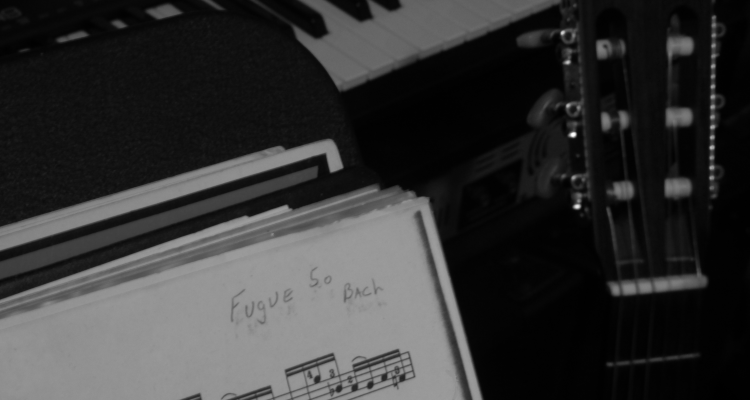
My Daily Guitar Practice
I thought that I would write out how I went through a typical daily practice session for guitar. I figured that it might be educational for beginner guitarists, because they could have some idea of how much time they could put into practice, and what they could expect as far as improvement.
Remember, not everybody gets the same results from the same type of practice, and different musicians have different goals. What works for me might not be your cup of tea.
1. First, I do a warm-up. I think that it’s important to get your hands stretched out and limber, not only to avoid injury, but to make it so that the first music you play doesn’t sound horribly sloppy. Sometimes, if I jump right into playing pieces, the first few pieces sound rough and that’s bad for my morale.
My warm-up starts with scales. I do all the scales that I know, both ascending and descending, in all positions on the neck (that’s not entirely true, I skip a few ridiculous positions but you get the idea). The scales are: major, major pentatonic, rock-blues, natural minor, melodic minor, harmonic minor, dorian mode minor, dominant 7th, whole-tone, diminished (whole-step, half-step), and diminished (half-step, whole-step). Something like that.
I do them in thirds, then fourths (I don’t mean third or fourth intervals exactly, but in patterns of three notes, then four notes, etc). You probably know what I mean (if you don’t ask me and I’ll explain).
Then, I do arpeggios. The complete run of scales and arpeggios takes me just under one hour.
2. Next, I do a set of chord studies. This is basically just playing every chord that I know while reading them from charts. The reason I do this is more to aid my chart reading ability rather than improving my physical chops or anything like that. The scales and arpeggios are generally for the same reason. The more comfortable I am with the sounds of the intervals that I’m playing in the scales and arpeggios, the easier it is for me to understand and remember chord theory.
This takes about 10 minutes.
3. After that, I do a set of sight reading exercise that force me to play patterns and duets along with another, previously recorded guitar. I found this set of exercises years ago but they’re still pretty tough. They start out very simply but move on to more challenging sight reading.
The sight reading takes about 15-20 minutes. With breaks I’m now 1 1/2 hours into practice and I’m warmed up.
4. Then I began repertoire. This is made up of playing through pieces that I’m sometimes familiar with, sometimes just starting, or sometimes studying a particular aspect of. My repertoire is broken into different sections (like wedding music, or Christmas pieces, or standard repertoire). I also try to add in my own songs so that I’m able to play them when I need to. I switch out the repertoire sections, so that I might play Standard Repertoire & Wedding Music one day, and then the next day it might be My Songs & Christmas Pieces or something like that.
I play certain pieces more than once if I think I need to in order to finally get the piece under my fingers. I’m also constantly paying attention to pain or discomfort in my hands, fingers, wrists and even my shoulders and neck. I’ve had a few issues with injuries that really scared me, thinking I had carpal tunnel or worse, so I try to be careful and stop if I feel any really sharp pains.
This kind of rehearsal/practice takes me about 3-4 hours daily. Recently, I’ve been taking Saturday & Sunday off. Sounds like slacking, but rest is important so that you come back stronger on Monday. You really can overdo it sometimes, trust me.
I practice more if I have a particularly worrisome session coming up, like something I have to record or perform. Then, I’ll practice those specific pieces over and over again and sort of ignore the other pieces. After the recording, I go back to my normal schedule.
So that’s it! That’s what I’ve been doing for practice the past couple of years. Let me know in the comments if you do it a different way or if you have any suggestions. Hopefully, this info can help another musician work out their schedule.
Happy playing!
Liked this post? Follow this blog to get more.